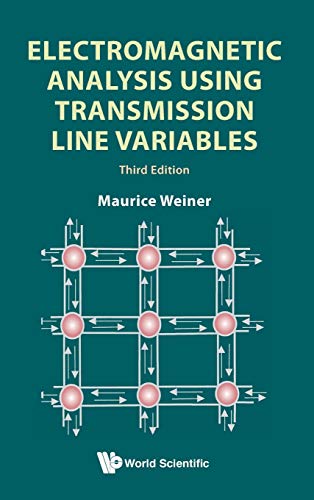

Electromagnetic analysis using transmission line variables / Maurice Weiner, formerly with US Army Research Laboratory, USA and United Silicon Carbide, USA.
Material type: TextPublisher: Hackensack, New Jersey : World Scientific, [2018]Publisher: ©2018Edition: Third editionDescription: xxvii, 623 pages : illustrations ; 24 cmContent type:
 - text
- unmediated
- volume
- 9789813225022
- 9813225025
- 9789813225039
- 9813225033
- QC 665 W45 2018
| Item type | Current library | Shelving location | Call number | Status | Date due | Barcode |
|---|---|---|---|---|---|---|
 Book
Book
|
TUP Manila Library | New Acquisitions-Ground floor | QC 665 W45 2018 (Browse shelf(Opens below)) | Available | P00031112 |
Includes bibliographical references and index.
Introduction to transmission lines and their application to electromagnetic phenomena -- Notation and mapping of physical properties -- Scattering equations -- Corrections for plane wave and anisotropy effects -- Boundary conditions and dispersion -- Cell discharge properties and integration of transport phenomena into the TLM matrix -- Description of TLM iteration -- SPICE solutions.
"This latest edition continues the evolution toward the ultimate realization of a new technique for solving electromagnetic propagation problems. The technique combines the classical and intuitive use of a transmission line matrix (TLM) while striving for consistency with the guideposts demanded by quantum mechanics and the essential structure of electromagnetic theory. The matrix then becomes a useful vehicle for examining both coherent and noncoherent electromagnetic waves. The goal is a mathematical tool capable of solving problems related to the propagation of transient, high-speed, complex waveforms containing both symmetric and plane wave components. For such waveforms, standard classical electromagnetic theory is unable to provide a truly accurate solution since it does not properly account for the correlations among the various TLM cells. The correlations among neighboring TLM cells allow the cell waves to sense one another and to collectively participate as a coherent wave. For arbitrary signals, e.g., complex, high speed, highly non-uniform signals, the correlation model must be placed on a firmer footing to insure the proper correlation strength based on the close adherence to quantum mechanical principles. The purpose of the Third Edition is to thereby improve the correlation model, and incorporate the model into the simulations. The simulation results thus obtained show great promise in describing the full range of electromagnetic phenomena. Wave divergence and diffraction simulations, employing both composite and shorter range correlation models, have been incorporated. The models employ correlation coefficients which may be linked with quantum mechanical parameters, thus providing a deeper understanding of coherent wave fronts"-- Provided by publisher.
There are no comments on this title.