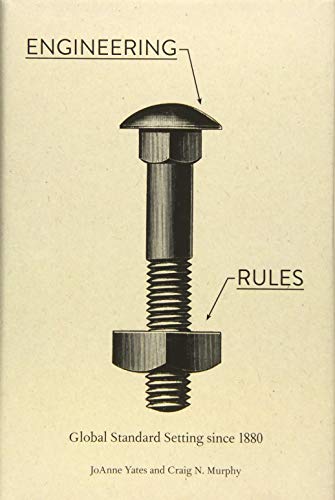

Engineering rules : global standard setting since 1880 / JoAnne Yates, Craig N. Murphy.
Material type: TextSeries: Hagley library studies in business, technology, and politicsPublisher: Baltimore : Johns Hopkins University Press, [2019]Description: xiv, 421 pages : illustrations ; . 22 cmContent type:
 - text
- unmediated
- volume
- 9781421428895 (hardcover : acidfree paper)
- 142142889X (hardcover : acidfree paper)
- TA 368 Y38 2019 Y38 2019
| Item type | Current library | Shelving location | Call number | Status | Date due | Barcode |
|---|---|---|---|---|---|---|
 Book
Book
|
TUP Manila Library | General Circulation Section-GF | TA 368 Y38 2019 (Browse shelf(Opens below)) | Available | P00033384 |
Includes bibliographical references (pages [343]-408) and index.
The first wave
Engineering professionalization and private standard setting for industry before 1900
Organizing private standard setting within and across borders, 1900 to World War I
A community and a movement, World War I to the Great Depression
The second wave
Decline and revival of the movement, the 1930s to the 1950s
Standards for a global market, the 1960s to the 1980s
US participation in international RFI/EMC standardization, World War II through the 1980s
The third wave
Computer networking ushers in a new era in standard setting, 1980s to 2000s
The development of a W3C standard: WebCrypto API, 2012-2017
Voluntary standards for quality management and social responsibility since the 1980s
It explores the history and impact of private, voluntary standards on the global economy. The book traces the evolution of standard-setting from the 1880s, when engineers established standards to assert their professional status and meet industrial needs, to its critical role in global manufacturing, the Internet, and international trade. By the 1920s, standardizers saw themselves as key to global prosperity and peace. After World War II, they bridged Cold War divisions to enable globalization. Since the 1990s, a new generation has applied standardization to the Internet and addressed social and environmental concerns. Using archival research, interviews, and direct observation, the authors reveal the profound yet often unnoticed influence of standards on modern life.
There are no comments on this title.