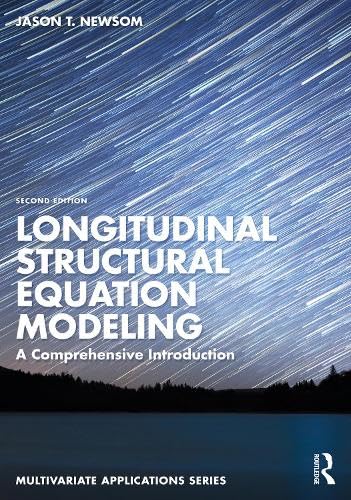

Longitudinal Structural Equation Modeling : A Comprehensive Introduction / Jason T. Newsom
Material type: TextLanguage: Undetermined Routledge, New York, c2024Edition: Second editionDescription: xx, 501 pages : illustrations (black and white) ; 26 cmContent type:
 - 9781000905984
- QA 278 N49 2024
| Item type | Current library | Shelving location | Call number | Status | Date due | Barcode |
|---|---|---|---|---|---|---|
 Book
Book
|
TUP Manila Library | Graduate Program Section-2F | GS QA 278 N49 2024 (Browse shelf(Opens below)) | Available | P00034181 |
Includes bibliographic references and index.
ContentsList of FiguresList of TablesPreface to the Second EditonPreface to the First EditionAcknowledgementsExample Data SetsChapter 1. Review of Some Key Latent Variable PrinciplesChapter 2. Longitudinal Measurement InvarianceChapter 3. Structural Models for Comparing Dependent Means and Proportions Chapter 4. Fundamental Concepts of Stability and Change Chapter 5. Cross-Lagged Panel ModelsChapter 6. Latent State-Trait ModelsChapter 7. Linear Latent Growth Curve Models Chapter 8. Nonlinear Latent Growth Curve ModelsChapter 9. Nonlinear Latent Growth Curve ModelsChapter 10. Latent Class and Latent TransitionChapter 11. Growth Mixture Models Chapter 12. Intensive Longitudinal Models: Time Series and Dynamic Structural Equation Models Chapter 13. Survival Analysis Models Chapter 14. Missing Data and Attrition Appendix A: Notation Appendix B: Why Does the Single Occasion Scaling Constraint Approach Work? Appendix C: A Primer on the Calculus of ChangeGlossaryIndex
"Longitudinal Structural Equation Modeling is a comprehensive resource that reviews structural equation modeling (SEM) strategies for longitudinal data to help readers determine which modeling options are available for which hypotheses. This accessibly written book explores a range of models, from basic to sophisticated, including the statistical and conceptual underpinnings that are the building blocks of the analyses. By exploring connections between models, it demonstrates how SEM is related to other longitudinal data techniques and shows when to choose one analysis over another. Newsom emphasizes concepts and practical guidance for applied research rather than focusing on mathematical proofs, and new terms are highlighted and defined in the glossary. Figures are included for every model along with detailed discussions of model specification and implementation issues and each chapter also includes examples of each model type, descriptions of model extensions, comment sections that provide practical guidance, and recommended readings. Expanded with new and updated material, this edition includes many recent developments, a new chapter on growth mixture modeling, and new examples. Ideal for graduate courses on longitudinal (data) analysis, advanced SEM, longitudinal SEM, and/or advanced data (quantitative) analysis taught in the behavioral, social, and health sciences, this new edition will continue to appeal to researchers in these fields." -- Back cover
Newsom, J. T. (2023). Longitudinal structural equation modeling: A comprehensive introduction (2nd ed.). Routledge.
There are no comments on this title.