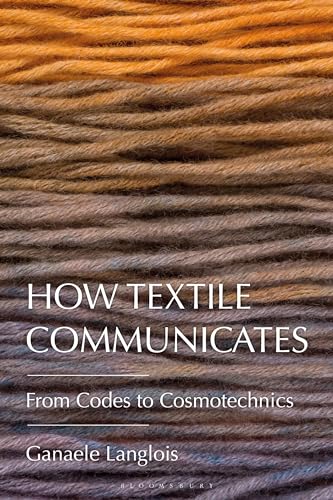

How textile communicates : from codes to cosmotechnics / Ganaele Langlois.
Material type: TextPublisher: London ; New York : Bloomsbury Visual Arts, 2024Description: vii, 211 pages : illustrations ; 25 cmContent type:
 - text
- still image
- unmediated
- volume
- 9781350384347
- 1350384348
- NK 8804 L36 2024
| Item type | Current library | Shelving location | Call number | Status | Date due | Barcode |
|---|---|---|---|---|---|---|
 Book
Book
|
TUP Manila Library | Graduate Program Section-2F | GS NK 8804 L36 2024 (Browse shelf(Opens below)) | Available | P00034236 |
Includes bibliographical references and index.
Introduction: Textile as Communication -- Part I. Communicative Power. Chapter 1. Unraveling Textile from Commodity to Communication ; Chapter 2. Quechua Textility -- Part II. Technology and Imagination. Chapter 3. Jacquard and the Creativity of Extensions ; Chapter 4. Communicating Across the Abyss -- Part III. Transformative Entanglements. Chapter 5. Reweaving the Interface ; Chapter 6. Kené, or the Promise of Un-knowing -- Part IV. Cosmomedia. Chapter 7. Cosmomedia: the Tale of Two Indigos -- Conclusion: The Shape of Things to Come.
"Textile has been used as a medium of communication since the prehistoric period. Up until the 19th century, civilizations throughout the world manipulated thread and fabric to communicate in a way that would astound many of us now. Unlike text and images, textile is haptic and three-dimensional. Its meaning is unfixed, constantly shifting as it circulates between different owners and creators. In How Textile Communicates, Ganaele Langlois dissects textile's unique capacity for communication through a range of global case studies, before examining the profound impact of colonialism on textile practice and the appropriation of this medium by capitalist systems. A thought-provoking contribution to the fields of both fashion and communication studies, Langlois' writing challenges readers' preconceptions and shines new light on the profound impact of textiles on human communication"-- Provided by publisher.
Langlois, G. (2024). How textile communicates: From codes to cosmotechnics. Bloomsbury Visual Arts.
There are no comments on this title.