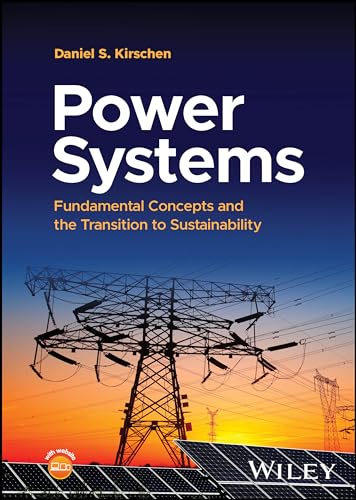

Power systems : fundamental concepts and the transition to sustainability / Daniel S. Kirschen.
Material type: TextPublisher: Hoboken, NJ : Wiley, 2024Copyright date: ©2024Description: xix, 316 pages : illustrations, maps ; 25 cmContent type:
 - text
- unmediated
- volume
- 9781394199525
- 9781394199518
- TK 1001 K57 2024
| Item type | Current library | Shelving location | Call number | Status | Date due | Barcode |
|---|---|---|---|---|---|---|
 Book
Book
|
TUP Manila Library | Graduate Program Section-2F | GS TK1001 .K57 2024 (Browse shelf(Opens below)) | Available | P00034242 |
Includes index.
"Electricity provides a clean, efficient, versatile, and economical way to deliver energy. Efficient generators have been designed to convert other forms of energy into electrical energy. Transmission lines carry large amounts of energy over long distances. Electric motors are efficient and make possible precise motion control. Electricity is also the only way to power electronic devices. However, there is one drawback to using electricity as an energy vector: storing significant amounts of energy in electrical form is not practical. Delivering significant amounts of electrical energy must therefore take place as a continuous process. The rate at which electrical energy flows (i.e., power) is the fundamental concept. Generating electric power from primary energy sources, transmitting it over long distances and converting it into another form of power for a variety of end uses on an uninterrupted basis requires a set of devices working in a coordinated fashion. This is what we call a power system"-- Provided by publisher.
Kirschen, D. S. (2024). Power systems: Fundamental concepts and the transition to sustainability. Hoboken, NJ: John Wiley & Sons.
There are no comments on this title.