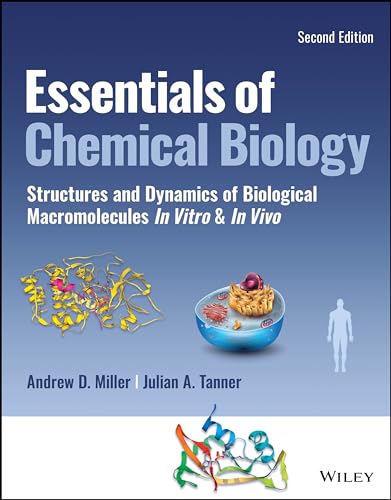

Essentials of chemical biology : structures and dynamics of biological macromolecules in vitro and in vivo / Andrew D. Miller, Department of Chemistry, Imperial College London, UK, Julian A. Tanner, Department of Biochemistry, University of Hong Kong.
Material type: TextPublisher: Hoboken, New Jersey : John Wiley & Sons Inc., [2024]Edition: Second editionDescription: xvii, 537 pages : illustrations (chiefly color) ; 25 cmContent type:
 - text
- unmediated
- volume
- 9781119437970
- QD 415 M55 2024
| Item type | Current library | Shelving location | Call number | Status | Date due | Barcode |
|---|---|---|---|---|---|---|
 Book
Book
|
TUP Manila Library | Graduate Program Section-2F | GS QD 415 M55 2024 (Browse shelf(Opens below)) | Available | P00034246 |
Includes bibliographical references and index.
The structures of biological macromolecules and lipid assemblies
Chemical and biological synthesis
Molecular biology as a toolset for chemical biology
Electronic and vibrational spectroscopy
Magnetic resonance
Diffraction and microscopy
Molecular recognition and binding
Kinetics and catalysis
Mass spectrometry and proteomics
Molecular selection and evolution
Chemical biology of cells
Chemical biology of stem cells to tissue engineering
Chemical biology, nanomedicine and advanced therapeutics
Chemical biology and advanced diagnostics leading to precision therapeutic approaches
DNA nanotechnology
"Since the first edition of this Textbook, Chemical Biology has now established itself as a major branch of scientific activity devoted to understanding the way Biology works at the molecular level. Chemical Biology itself remains unashamedly multidisciplinary, and Chemical Biology research is essentially problem driven and not discipline driven. Organic, Physical, Inorganic and Analytical Chemistry all contribute towards Chemical Biology alongside newer emerging molecular disciplines. Some might say that Chemical Biology is just another way to rebadge Biochemistry. However, such a comment misses the point. Biochemistry may have started as a discipline devoted to the study of individual biological macromolecules, but this discipline has been steadily evolving into increasingly descriptive, empirical studies of larger and larger macromolecular assemblies, structures and interacting molecular networks. The molecular increasingly gives ground to the cellular. In contrast, Chemical Biology is about Chemistry trained graduates and researchers taking a fundamental interest in the way Biology works. Consequently, the focus is on the molecular and the quantitative where molecular properties are investigated, studied and then gradually linked to macromolecular and cellular behaviour where possible. This is a fundamentally bottom-up approach to understanding Biology in keeping with the chemist's natural enthusiasm and appreciation for molecular structure and behaviour first and foremost"-- Provided by publisher.
Miller, A., & Tanner, J. (2024). Essentials of chemical biology: Structures and dynamics of biological macromolecules in vitro and in vivo (2nd ed.). John Wiley & Sons Inc.
There are no comments on this title.