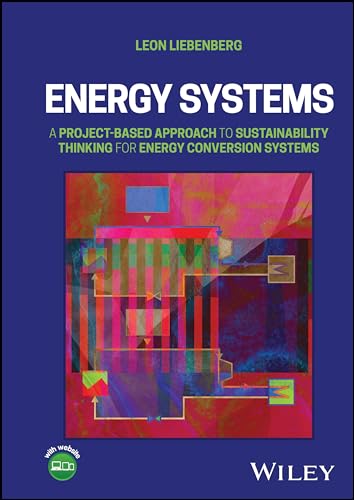

Energy systems a project-based approach to sustainability thinking for energy conversion systems/ Leon Liebenberg (Author)
Material type: TextHoboken, John Wiley & Sons, Inc., c2024Description: xxix, 683 pages : illustrations ; 26 cmContent type:
 - text
- unmediated
- volume
- 9781119869467
- TJ 163.2 L54 2024
| Item type | Current library | Shelving location | Call number | Status | Date due | Barcode |
|---|---|---|---|---|---|---|
 Book
Book
|
TUP Manila Library | Graduate Program Section-2F | GS TJ 163.2 L54 2024 (Browse shelf(Opens below)) | Available | P00034376 |
Includes bibliographic references and index.
Week 1: What is energy? Introduction to energy
Conservation of quantity of energy
Destruction of quality of energy
Week 2: Energy, society, and environement. Energy usage and society
Energy usage and the environment
Interpretations of sustainability
Week 3: Fuels. Chemical fuels
Oil and natural gas, and hydrogen and biofuels
Week 4: Gas cycles. Internal combustion gas engines
External combustion gas engines
Emission control of internal and external combustion engines
Week 5: Vapor power cycles and vapor refrigeration cycles. Steam power plants
Refrigeration and air-conditioning
Controlling emissions from vapor power cycles and vapor refrigeration cycles
Week 6: Nuclear power. Nuclear physics
Nuclear fission and fusion power plants
Controlling waste and emissions from nuclear power plants
Week 7: Direct energy conversion. Concepts of direct energy conversion
Solar electricity
Fuel cells and electrolyzers
Week 8: Solar-thermal and wind energy systems. Solar heating
Solar-thermal electrical power plants
Wind energy
Week 9: Energy storage (including water and geothermal power). Waterpower and pumped storage, tidal and wave power
Geothermal energy and storage
Storage of electricity and heat
Week 10: Decarbonizing transportation, buildings, heavy industry, and power generation. Decarbonizing transportation, buildings, industry, and electrical power
This multidisciplinary and comprehensive text features an up-to-date summary of salient energy technologies for quick reference by students and practitioners of energy engineering. Uniquely, the book employs a guided self-study approach with theory provided in “bite-sized” chunks, several worked examples, quantitative and qualitative practice problems, 10 real-world mini-projects, and interviews with young energy innovators and engineering students. The book poses many big and pressing questions, asking the reader to “reimagine our future,” particularly with a focus on sustainable energy. These questions are aligned with characteristics of an entrepreneurial mindset, which are emphasized throughout the book. The book reviews the fundamentals of thermodynamics, fluid mechanics, and quantum mechanics. Chapters explore the full range of energy conversion technologies, including energy supply and demand, the science of global warming, interpretations of sustainability, chemical fuels, carbon capture and storage, internal and external combustion engines, vapor power and refrigeration plants, nuclear power, solar-electricity, solar-heat, fuel cells, wind energy, water energy, and energy storage. The book ends with a brief investigation into what we can do to decarbonize the transportation, industry, buildings, and electric power sectors. Energy Systems: A Project-Based Approach to Sustainability Thinking for Energy Conversion Systems offers an accessible overview of this important subject with an innovative, easy-to-use organization. Built to facilitate active learning and representing the latest research and industrial practice, Energy Systems provides readers with tools and information to evaluate energy systems and to reimagine potential energy solutions." Back cover
Liebenberg, L. (2024). Energy systems: A project-based approach to sustainability thinking for energy conversion systems. John Wiley & Sons.
There are no comments on this title.